
Trusted research and scientific insights into microcurrent therapy
Microcurrent therapy has evolved from early experimental investigations into a well-studied modality applied in rehabilitation, aesthetics, and wellness.
Over the past five decades, researchers have examined how low-level electrical currents can influence tissue repair, pain modulation, neuromuscular recovery, and aesthetic outcomes. This evidence library consolidates the most credible research, grades evidence by clinical application, highlights study limitations, and provides a glossary to help readers understand key terminology.
For clinicians, wellness professionals, and informed consumers, this page serves as a comprehensive starting point for evidence-based information on microcurrent therapy.
Microcurrent therapy operates at extremely low levels of electrical current, usually in the microampere range. These currents are intended to support the body’s natural bioelectric signals rather than overwhelm them.
Across diverse applications, microcurrents are used to accelerate tissue repair, support functional recovery, reduce pain, and enhance skin appearance. Unlike other electrical stimulation technologies, microcurrent therapy works below the sensory threshold, allowing treatment without discomfort or involuntary muscle contraction.
What the Research Says
High-quality research on microcurrent therapy has steadily increased since the 1970s. The field now includes randomized controlled trials, systematic reviews, case studies, and clinical observations across multiple disciplines. These studies consistently indicate promising benefits in several key areas.
Wound Healing
Microcurrent therapy has demonstrated measurable benefits in chronic and acute wound healing. It has been associated with accelerated tissue repair, improved collagen synthesis, and stronger scar formation. A 2021 meta-analysis concluded that microcurrent therapy combined with standard wound care significantly reduced wound surface area and shortened healing time by approximately seven days compared with standard care alone, while also reducing perceived pain and producing no increase in adverse events (Electrical Microcurrent Stimulation Therapy for Wound Healing, Tissue Viability Society, 2021)
These findings are particularly relevant for diabetic foot ulcers, pressure ulcers, and venous leg ulcers, where standard care alone often produces slower healing rates. Researchers attribute these benefits to the enhancement of ATP production and cellular migration, which are crucial for tissue repair.
Pain Modulation
Microcurrent therapy also shows efficacy in reducing chronic musculoskeletal pain. It works by modulating sub-sensory nerve pathways and supporting underlying physiological repair mechanisms rather than temporarily masking pain. A systematic review found that microcurrent therapy significantly improved pain in patients with shoulder and knee disorders compared with sham treatments and was associated with no severe adverse events (Microcurrent Therapy as a Therapeutic Modality for Musculoskeletal Pain, PMC, 2021)
In practical terms, this means that patients may experience gradual and sustained reductions in pain while tissue function is supported and inflammation is moderated. Clinicians have incorporated these findings into multimodal treatment plans for post-operative recovery, musculoskeletal injuries, and chronic soft tissue conditions.
Neuromuscular Recovery
Another area supported by research is neuromuscular rehabilitation. Microcurrent therapy has been shown to enhance muscle tone, support functional recovery after injury, and assist in maintaining neuromuscular coordination. Clinical studies indicate that treatment can reduce delayed onset muscle soreness (DOMS), improve muscle performance after intensive exercise, and support soft tissue recovery when integrated with standard physical therapy (Curtis et al., Journal of Athletic Training, 2010)
For patients recovering from surgery or injury, microcurrent therapy can be a valuable adjunct, promoting natural bioelectrical signalling that aids in muscle re-education without forcing contraction or risking tissue fatigue.
Aesthetic Applications
Microcurrent therapy has also gained traction in aesthetics for its potential to improve skin quality, texture, and firmness. Evidence shows that repeated sessions can lead to subtle yet measurable improvements in facial contour, jawline definition, and skin smoothness. While microcurrent facials do not provide dramatic lifting comparable to surgical procedures, they support long-term skin health and serve as non-invasive maintenance therapy.
In clinical observations and small-scale studies, clients receiving regular microcurrent treatments report improvements in fine lines, puffiness, and skin tone, with results described as natural and cumulative over time. These outcomes align with broader trends in non-invasive aesthetics, where subtle, consistent improvements are increasingly preferred over dramatic interventions.
Interpreting Research Context
While the evidence is encouraging, outcomes must be interpreted in context. Variability in study protocols, patient populations, treatment duration, and current intensity can influence results.
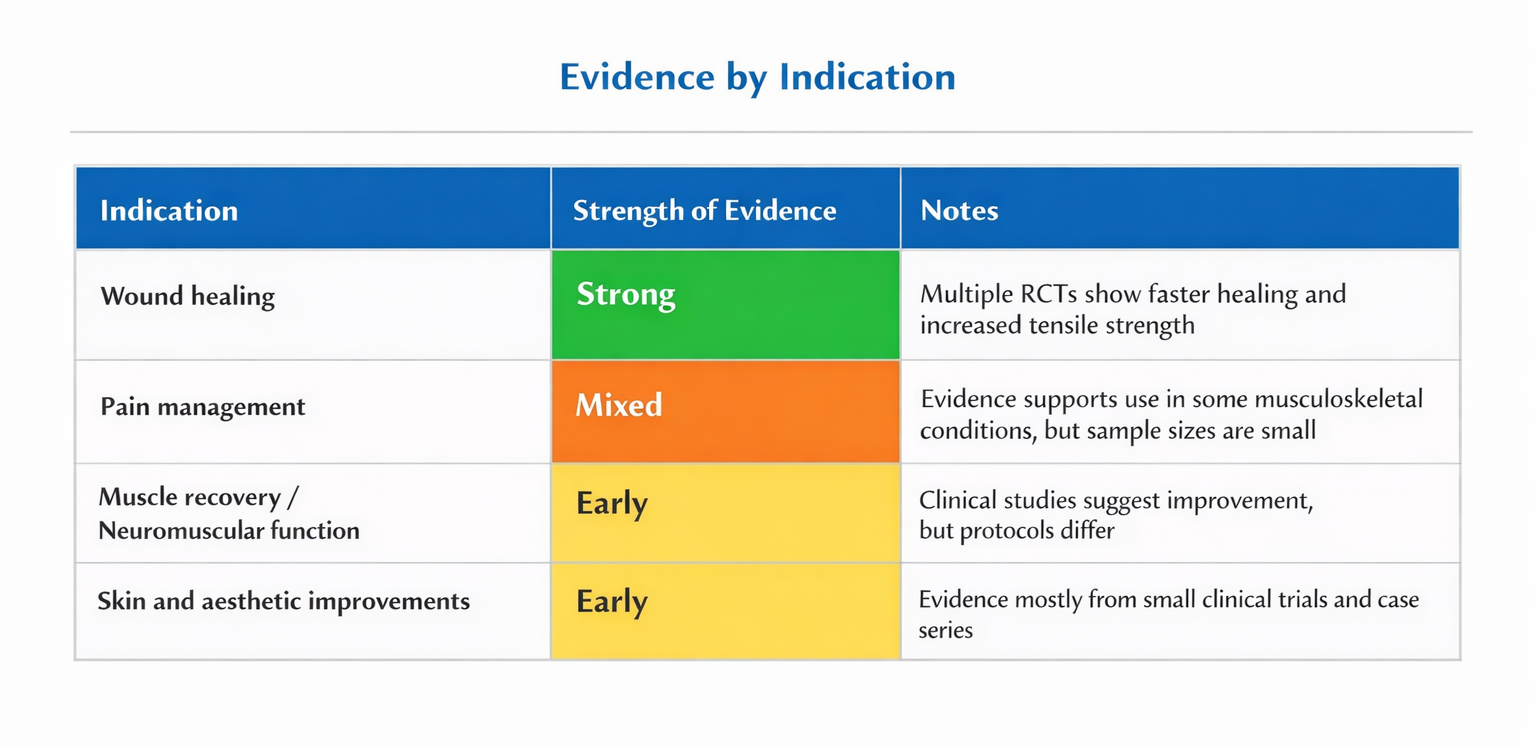
The effectiveness of microcurrent therapy may differ between chronic wound care, sports rehabilitation, and aesthetic applications. This graded approach helps clinicians and informed consumers understand where evidence is strongest and where it is still emerging.
Limitations and Controversies
Even as research expands, several limitations remain in the microcurrent literature.
- Placebo Effects: Subtle sensations associated with treatment may influence subjective reporting of pain relief or skin improvement.
- Small Sample Sizes: Many clinical trials involve relatively few participants, often 10 to 50, limiting generalizability.
- Inconsistent Protocols: Differences in amplitude, waveform, frequency, and session duration make comparisons between studies challenging.
- Outcome Measures: Some studies rely on self-reported pain scales or visual assessment of skin quality rather than objective biological markers.
Awareness of these limitations ensures that clinicians set realistic expectations and highlights the need for continued high-quality research. It also reinforces the importance of combining microcurrent therapy with other evidence-based treatments in rehabilitation and aesthetic practice.
Glossary
Navigating clinical research can be challenging. Here are key terms used in studies:
Using this glossary allows readers to critically evaluate studies and determine which findings are robust and applicable to practice.
RCT (Randomized Controlled Trial)
A study design considered the gold standard for testing treatment efficacy.
Effect Size
The magnitude of a treatment’s benefit, providing context beyond statistical significance.
Bias
Systematic errors that may distort study findings.
Endpoints
Specific outcomes measured in a study, such as wound closure, pain scores, or muscle strength.
Positive Evidence and Clinical Insights
- A meta-analysis of wound healing studies reported significant reduction in healing time, improved tissue integrity, and decreased pain (Electrical Microcurrent Stimulation Therapy for Wound Healing, Tissue Viability Society, 2021)
- Systematic reviews on musculoskeletal pain demonstrate that microcurrent therapy improved shoulder and knee pain outcomes without serious adverse events (Microcurrent Therapy as a Therapeutic Modality for Musculoskeletal Pain, PMC, 2021)
- Clinical studies in athletic populations show reduced delayed onset muscle soreness and faster perceived recovery after microcurrent treatment (Curtis et al., Journal of Athletic Training, 2010)
These examples underscore that microcurrent therapy is not experimental; it is supported by measurable improvements across diverse patient populations and applications.
Why This Matters
By consolidating the strongest evidence, grading indications, and clarifying limitations, this library positions microcurrent therapy as a scientifically grounded modality rather than a trend. Users can confidently explore applications in rehabilitation, wellness, and aesthetics, understanding where outcomes are supported and where research is still emerging.
For deeper insights, explore individual case study summaries and links to original research, which provide context for clinical decisions, protocol design, and expected outcomes. This approach equips practitioners, educators, and informed consumers with the knowledge needed to integrate microcurrent therapy safely and effectively.